A Powerful Story of War, Memory, and Morning Rituals
By Michael Blankenship
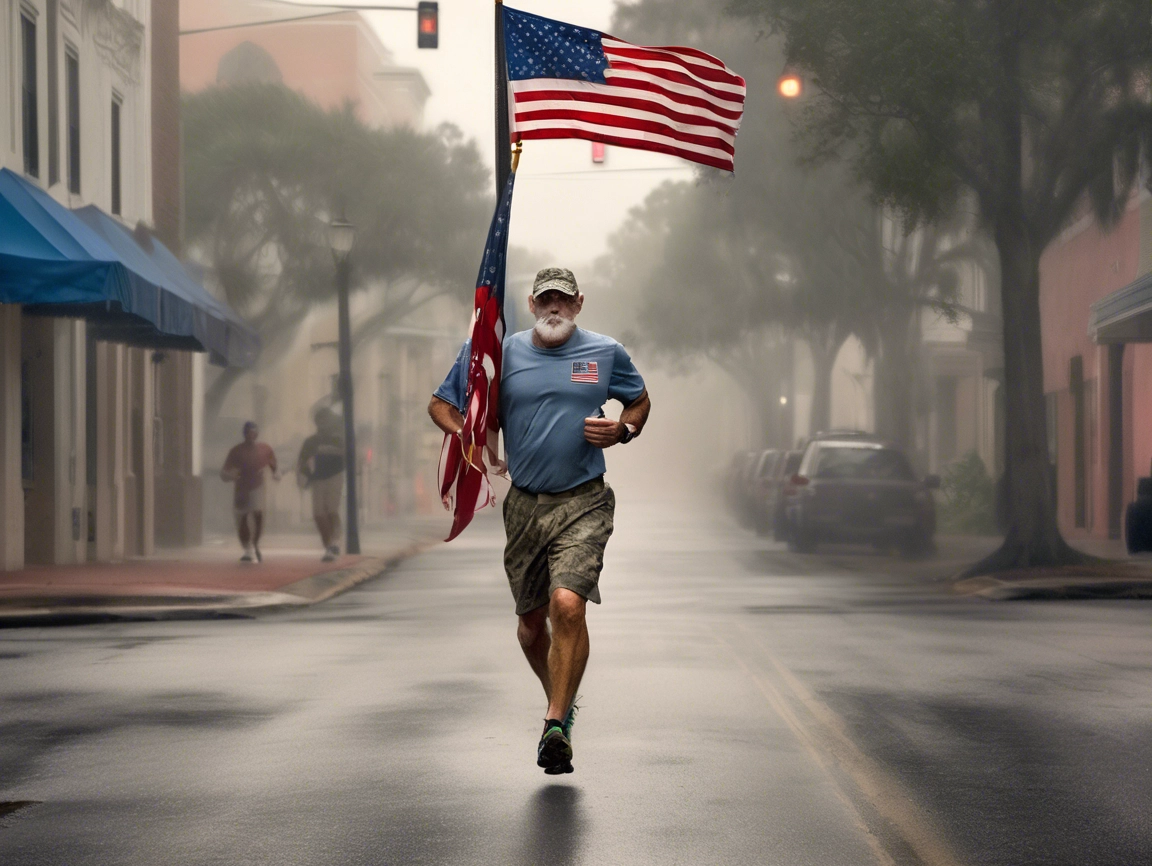
The flag snaps behind me like a rifle crack, catching the wind as I break into a steady rhythm on Cervantes Street. Wednesday morning is thick with humidity—Florida summer, already pushing heat through the concrete—and I let it cling to me. Sweat, salt, silence. All familiar. All earned.
This isn’t the flag I carried with me during deployments. That one stays in the cedar box I lined with blue velvet, tucked high on a shelf. This one flies because I’m still breathing.
I run ten miles each morning—down through the heart of downtown, along the shoreline, past the old VFW and back. It started as five, but somewhere along the way, five wasn’t enough to carry everything I was holding. So now it’s ten. Some days, even that’s not enough.
My shoes thump out a rhythm—one-two-three, one-two-three. It’s a cadence I stole from the desert, from the pre-dawn patrols and the heartbeat of movement that kept us sane. Thomas used to call it “clearing the static.”
Back then, he’d drag us out after missions, laugh while we cursed him. “Come on,” he’d say. “Motion is medicine.” And he’d be right. He always was.
When we lost him, I took up the habit. At first, to honor him. Then, because I had to. The VA shrinks call it displacement activity. I call it survival.
Downtown is waking up as I pass. The bakery smells like heaven, frying donuts for the pier crowd. A group of delivery drivers waves—familiar faces now. Some honk. One salutes. I nod. Keep running.
They see the flag. Not the war.
At Palafox, a family waits to cross—dad wrangling a stroller, mom balancing iced coffees. Their son, maybe eight, holds a scooter by the handlebars, one foot already nudging the curb. As I pass, he shouts, “Thank you!”—clear, loud, too honest for irony. His mother’s hand clamps his shoulder fast, like she touched a wire. Her smile is tight, uncertain. I nod. I smile too, even though it pinches. Keep running.
The wind’s against me now, tugging at the flag, asking me to turn back. But that’s not what today is. Today, I run the full ten.
Near Alcaniz, the church sits empty. The pastor leaves water on the steps every morning—a kind gesture wrapped in silence. I slow, grab a bottle. He nods from the doorway. Religion scares me. We’ve never spoken. I think he knows that’s best. I keep moving.
The wind shifts, gritty and dry, and for a moment, the street blurs. I’m back in Baghdad. Late afternoon. A sandstorm ghosting in across the flat. Thomas jogs ahead, glancing back over his shoulder.
“You’re slow,” he says.
“You’re insane,” I counter.
He tosses his cap at me. “Tag, you’re it.”
We’re both laughing when the blast hits.
There’s a moment of suspended silence before the sound comes roaring back like a tidal wave. Screams. Metal. Blood. My hands shaking so hard I couldn’t grip my weapon.
I blink hard, and I’m back. I trip on a sidewalk crack. A car honks. Not a thank you this time—just frustration. I wave an apology, push forward.
Past Garden Street, the neighborhoods change. Fewer tourists, more quiet porches. I pass a weathered man wearing a U.S. Navy cap and sitting on a milk crate outside a shuttered bait shop. He sees me and nods once.
I nod back.
At three miles, I turn onto Bayfront Parkway. The sun flashes off the water like a signal mirror. My thighs burn now, but I welcome it. Pain’s honest. It reminds me that I feel.
Up ahead, near the edge of the old cannery park, I spot a familiar silhouette. Jace.
He’s standing next to a rusted bench, one leg stiff, his shepherd mix panting beside him. First time I’ve seen him off his porch.
“You’re early,” he calls out.
“You’re mobile,” I reply, breath short.
He chuckles. “Thought I’d see how far I could limp today.”
I slow just enough to pass near. Gunner wags his tail once. “You ever gonna run the parade?” Jace asks.
“Too many people,” I say. He understands.
I keep moving. The wind shifts again, and the flag billows full. Behind me, I hear Jace call after me,
“Keep carrying it.”
I don’t turn. But I nod. I think he sees it.
I drop back into rhythm—one-two-three, one-two-three—as Bayfront narrows into a stretch of sun-bleached sidewalk that hugs the water. Gulls cry over the bay, diving for scraps. An angler watches me pass, elbow deep in bait, nodding without speaking. I nod back.
The wind here carries brine and the distant promise of fried food. I can smell the pier before I see it—grease and sugar and salt. The scent clings like childhood.
There’s tension in the air. I can’t explain it, but I feel it in my ribs. Like the charge before a summer storm. Like memories surfacing too fast.
Ahead, near the crosswalk by the boat ramp, she stands.
A woman in a denim vest, a veteran’s patch stitched across the back. Wearing her gray hair in a tight braid, she cradles a framed photo.
I know before I see it.
She holds it to her chest as I approach, the way one might carry a Bible, or a child, or a bomb that’s already gone off. The man in the photo is young. A Marine. Smile too wide for war. I don’t need to be told he didn’t come back.
I slow, not enough to stop, but enough to see her eyes. She doesn’t cry. Doesn’t speak. Just nods.
I nod back.
In that half-second, the space between us closes with everything neither of us can say.
Then I’m past her, and the static returns.
FOB Lionheart, the week before the blast. Thomas and I sat on crates behind the mess tent, cooling off after a run. Our backs against the cinderblock wall, steam rising off our skin like we were still boiling inside.
“You think we’ll know when it’s over?” he asked.
“What?”
“The war. When we’re done with it.”
I shrugged. “You think there’s a finish line?”
He smiled, slow and sad. “Maybe not. Maybe it just gets quieter.”
It never got quieter. Just changed pitch.
At mile five, my legs ache in that low, familiar throb. I lean into it. Pain means you’re still in it. Still earning the air you take up.
There’s a jogger ahead—a younger guy in athletic gear, earbuds in. He sees me coming, steps aside. I nod, and he does a double-take when he sees the flag. Pulls his earbuds out.
“Hey,” he calls. “You’re the guy from the local story, right? The vet who runs with the flag?”
“I guess.”
He jogs beside me for a few steps. “That’s… intense.”
“Not as intense as staying still.”
He grins nervously, fades back. I don’t blame him.
By mile five and a half, I reach the memorial park.
There’s a wall here. Granite, dark as oil. Names etched in quiet rows. No guards, no ceremony—just stone and sun and silence.
I never stop.
But today, I do. Just for a breath.
I rest my hand against a name I know by heart. T. G. HAYES. Thomas.
I whisper nothing. Just breathe, eyes closed.
When I pull away, a man is sitting nearby on a bench, watching me. Maybe my age. Maybe older. Hard to tell. The desert strips years off some and adds them to others.
His arm is in a sling. A cane rests between his knees.
“You served with him?” he asks, gesturing to the wall.
“Yeah.”
“I was with the 10th Mountain,” he says. “Kunar Province. Got back, but not all the way.”
I nod. We all know what that means.
He pulls something from his jacket pocket and hands it to me. A folded scrap of paper.
“I write their names,” he says. “The ones I couldn’t save. Carry it when I walk. You want to trade?”
I take it. Add it to my pocket.
“I’m Mike.”
“Terrence.”
“Keep walking, Terrence.”
“Keep running, Mike.”
We don’t shake hands. It would feel small.
At six miles, the sun is full overhead. Sweat streams into my eyes. I wipe my face with the back of my arm, shoulders heavy from the flag.
Just before the shoreline bends again, I see him—a boy on a bench, legs swinging, notebook in his lap. His mom sits beside him, face turned toward the sea, fingers tight around a to-go coffee.
I pass without slowing.
Then I hear, “Hey, mister!”
I stop.
The boy runs toward me, sketchbook flapping in one hand.
“My dad served too,” he says, catching his breath. “Marine. We saw you run last week. I drew you.”
He holds up the page. A charcoal sketch, messy but vivid: a man with a flag trailing behind like a comet. A halo of movement around his body. His face blank—no details. Just motion.
“It’s good,” I say.
He shrugs. “I didn’t know what your face looked like.”
I tap the flag. “That’s the part that matters.”
He smiles. “I wanna be a Marine.”
I meet his eyes. Serious brown ones.
“You be someone who remembers,” I say. “That’s the hardest job there is.”
He nods solemnly. Like I’ve handed him something sacred.
And maybe I have.
Mile seven comes with a pull in my left calf and a hitch in my breath. My body is arguing. I don’t blame it. But I don’t stop.
This is where the run starts to strip things away.
The heat burns the last excuses out of you. Your breath stops being something you control and becomes something you fight for. And if you’re lucky—if you go far enough—you find a kind of rhythm underneath all the pain. A truth.
I round the bend toward the pier.
There are tourists here now, lining up for kettle corn, snapping selfies against the bay. A few wave. One salutes.
I don’t break stride.
There’s an old man on a bench feeding gulls from a bag of bread crusts. He sees me and stands—not fast but deliberate—and places a hand over his heart. I catch the glint of a Vietnam service pin on his collar.
I lift two fingers from my chest. The movement is slight, but he sees.
We both do.
Mile eight, and I’m back near the church again. Pastor’s not on the steps this time, but the water’s still there. I grab one, drinking on the move now, my throat raw from salt and silence.
The cicadas have started up. Their buzz follows me like static from an old radio, the kind that crackles between stations. Sometimes it sounds like voices. Sometimes I imagine it’s Thomas, calling cadence in that hoarse half-laugh of his.
One-two-three. One-two-three.
I still see him, early on—before the firebases and the body bags—when we conducted a joint patrol with locals. No interpreter. Just hand signals and prayers.
We spent six hours in blistering sun and walked seventeen kilometers for a contact who never showed up. At one point, Thomas pulled me aside, took off his helmet, and said, “You know what this is, right?”
“What?”
“This is gonna be the memory that keeps us alive later.”
I frowned. “That’s not how it works.”
“Sure it is,” he said. “One good thing gets you through the next bad one.”
He was wrong, of course.
But I wish he weren’t.
Mile nine now. My vision narrows. Everything is colors and motion and the smell of ocean rot and hot concrete. My legs feel hollow. My lungs stretch like canvas.
But I know the route by heart.
Up ahead: the boardwalk overlook. The railings are rusting but sturdy. I reach it and climb the shallow steps. The flag tugs at my back like a hand. The wind has picked up, steady and strong.
I stop.
The world quiets.
Below me, the water stretches out to the edge of knowing. Blue-gray, dappled with morning sun, it moves in constant breath. Back and forth. Pull and return.
I kneel at the railing.
The flag flaps behind me like it’s still running.
I whisper their names.
Thomas. Ramirez. Cole. Sergeant Brenner. Little Ortiz with the crooked grin. Fowler, who carried too much hope in his chest. Even the ones whose names I’ve forgotten but whose faces sit behind my eyes when sleep turns sideways.
I whisper them all.
And then I speak one more.
“Mine.”
Because a part of me died out there, too. And a part of me runs to remember that it didn’t take everything.
I rise. Turn back.
The last stretch brings me full circle—Cervantes, where the flag first snapped in the wind. Pensacola is awake now. Roads hum with morning traffic. A fire engine wails in the distance. Someone shouts from a stoop.
I don’t hear what they say. But I run through it. All of it. The grief. The praise. The forgetting.
The flag still flies behind me. Not for the country, but for the fallen. For the ones still walking with pieces missing. For the silence we can’t ever seem to outrun.
When I reach the place I started, I slow. Let the breath return on its own.
Ten miles. Ten thousand memories.
I bend, hands on knees, the sweat falling like prayer beads from my brow.
I don’t stop running because the war is over. I run because I still carry it.
Because the people who pass me need to see someone carrying it. Because one day, someone else might need to.
But not today.
Today, I carry the flag.
And it carries me.